On the occasion of the reinstallation of the Textile Gallery, on Wednesday 26 February 2025 Palazzo Madama presents an exhibition that explores the close material and symbolic connection linking white—the natural colour of silk and linen—to women.
Through a selection of fifty textile artefacts preserved in the collections of Palazzo Madama—six of which have been restored for this occasion and fourteen displayed for the first time—curator Paola Ruffino guides visitors along a centuries-long history, from minute embroidery and intricate lacework to the most iconic white garment associated with women: the wedding dress.
Medieval linen embroidery, needle and bobbin lace-making, and white-on-white embroidery are arts through which women’s hands have created masterpieces. This subtle and indissoluble bond runs through the centuries and sees women as authors, creators and guardians of tradition, as well as refined users and patrons of textiles and fashion accessories.
A key moment in the history of white fashion in France and Europe comes at the end of the eighteenth century. The fascination with Greek and Roman statuary inspired clothing that looked to antiquity. Young women adopted simple en-chemise dresses, gathered at the waist with a sash; the model of the cingulum worn by married Roman women, positioned high under the bust, gave rise to a fashion that would last for thirty years. Preferred fabrics included cotton muslins, silk gauzes and lightweight satins, white or with tiny patterns, reminiscent of porcelain tea services.
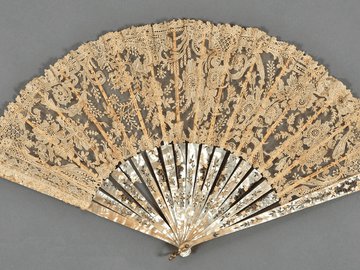
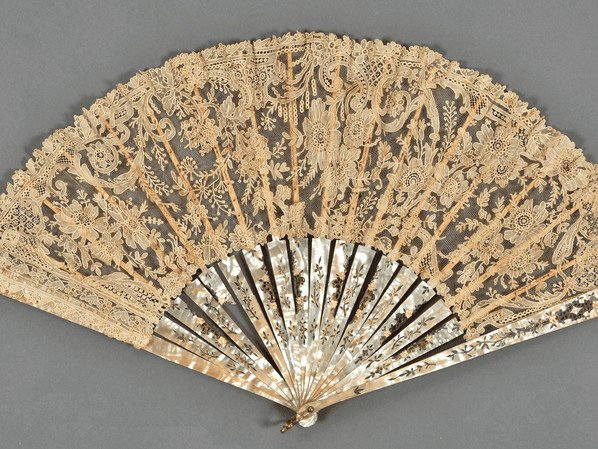
Around this central theme—illustrated by dresses, miniatures, fans and women’s accessories—the exhibition explores both past and future.
The fourteenth and fifteenth centuries are evoked by embroideries from women’s monasteries, particularly from German-speaking areas and the Lake Constance region, worked in linen on natural linen ground. Here the design, composed of simple yet widely varied stitches, is defined solely by an outline in coloured silk. Because of the modesty of the materials and the ease of execution, this type of work later spread into the secular domestic sphere, used to decorate tablecloths and cushions.
In Italy, decorative motifs of medieval Mediterranean origin—such as birds, castles and trees of life—persisted for a long time on household linens. These motifs are outlined in white on objects made of rensa cloth, a sheer and lightweight fabric, of which two rare examples are on display, possibly Sicilian or Sardinian.
Between the sixteenth and seventeenth centuries, lace-making emerged in Europe, with brilliant white linens and the extraordinary skill of Venetian and Flemish lacemakers taking centre stage. A selection of Italian and Belgian lace borders and accessories illustrates the exceptional decorative achievements of this exclusively female art, which in the eighteenth century moved beyond the narrow confines of the home or convent and became organised into manufactories.
In the nineteenth century, the advent of mechanised production led to a loss of virtuosity in the manual art of lace-making; this virtuosity, however, re-emerged in white-thread embroidery on fine batiste and muslin used for women’s handkerchiefs. Four splendid examples demonstrate the high level of refinement achieved by these accessories, decorated with embroidery that—unlike the polychrome silk and gold embroidery of large furnishings, liturgical textiles and garments, which since the Middle Ages had also been practised by men—remained an exclusively female activity, even when carried out at a professional level.
The exhibition concludes in the twentieth century with one of the themes that most closely unites women and the colour white in our tradition: the wedding dress. On display is a short dress from 1970, paired not with a veil but with an avant-garde cagoule—an unconventional choice that underscores the strength and persistence of the relationship between the image of women and the purity of white.
In the exhibition design, the selection of textiles is juxtaposed with various works of applied art, including miniatures, prints, porcelain and bookbindings from the museum’s collections.