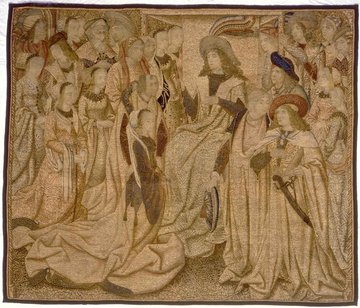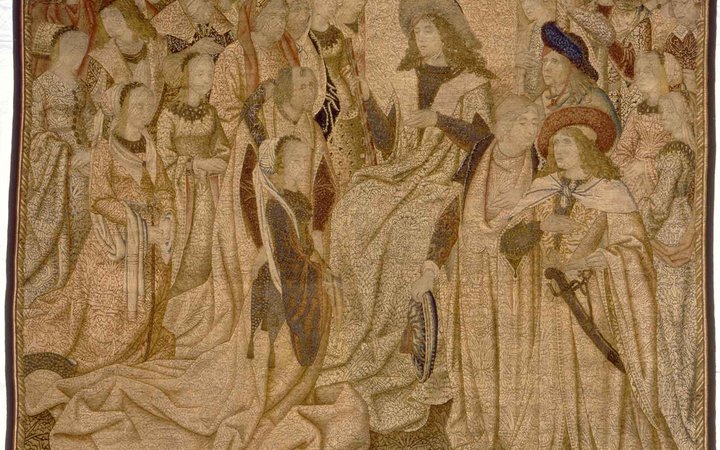
Woven in Brussels between the late f15th and early 16th Centuries in wool, silk, and metallic threads, the tapestry Esther Presented to Ahasuerus arrives at one of the symbolic sites of memory of the Italian deportation to spark a contemporary reflection on identity, power, and responsibility. The figure of Esther, protagonist of the biblical narrative, stands at the heart of this dialogue between past and present: a woman capable of becoming a bridge between a threatened people and the power that can guarantee their salvation, embodying a story of courage and intercession which, within the context of the Memorial, takes on a profoundly contemporary meaning.
Through these contributions, the tapestry reveals itself as a work able to speak to the present. In its gold threads, solemn gestures, and restrained gazes, universal themes emerge—the vulnerability of minorities, the weight of individual choices, the role of intercession—which, placed within the spaces of the Shoah Memorial, transform Esther Presented to Ahasuerus into a prism through which to examine the relationship between power and minorities, between representation and identity, between history and memory.
“Esther is one of the most significant figures of the biblical tradition: an extraordinary woman who combines beauty, intelligence, courage, and loyalty to her people threatened with extermination. Her story speaks of fear and prejudice, but also of dialogue and reconciliation,” explains Marco Vigevani, curator of the exhibition. “She has inspired artists of every era, including the creators of the magnificent tapestry Esther Presented to Ahasuerus, which the Museo Poldi Pezzoli has generously agreed to lend to us in order to organize this exhibition together. The exhibition will seek to illuminate the various aspects of the biblical story and of the tapestry through lectures, readings, and musical moments. The encounter between the Memoriale della Shoah of Milan and the displayed tapestry makes it possible to build bridges between different eras, fostering reflection on the fundamental issues of our present time.”
The collaboration between the Museo Poldi Pezzoli and the Memoriale della Shoah di Milano thus takes shape as a shared cultural project, bringing ancient art into dialogue with civic memory. In this exchange between institutions, the story of Esther emerges as a timeless narrative, still capable today of speaking about choice, speech, and responsibility in human history.